
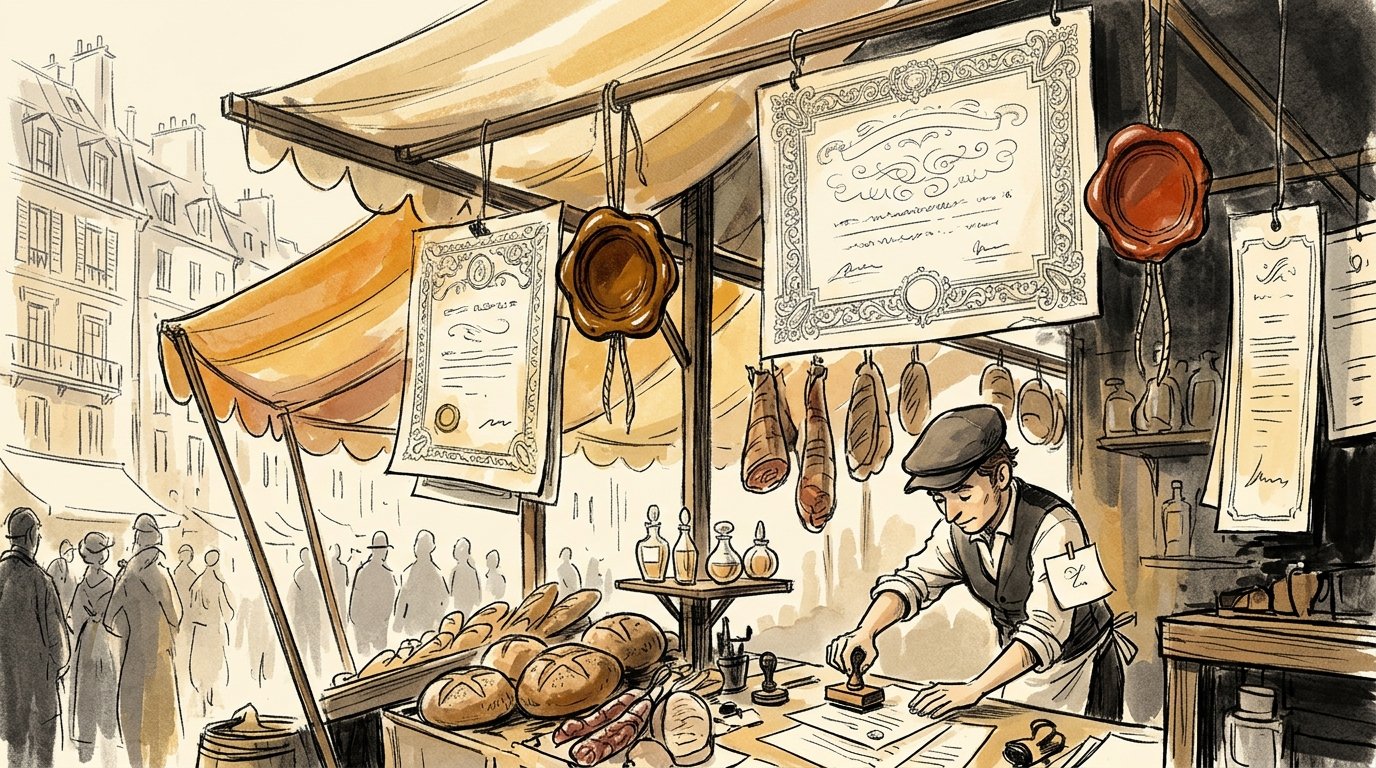
When the certificate of heaven arrives with an annual renewal fee and a QR code
Bonjour, dear reader. Pull up a chair.
The morning sun is doing that thing it does to the awning, the baker has just pulled the first croissants of the day from the oven, and I have ordered you a café crème while lining up a second pastry for myself.
Today we speak of food, faith, and money, and one cannot discuss such a trinity on an empty stomach. Sit. Taste. Roll your eyes with me, but affectionately.
The subject is the halal economy, and I must be clear from the first bite: I am not here to laugh at the believers. The Muslim family in Lyon that wants to know their meat was butchered with dignity, the student in Oslo scanning a chocolate bar for a stamped logo, the grandmother who has eaten this way for sixty years before anyone thought to monetize her dinner, these are not my quarrel.
Faith practiced at the table is one of humanity’s older and gentler inventions. My quarrel is with what happens after faith walks into a boardroom and is handed a rate card.
The Paperwork of Paradise
Because here is the scene. An industry worth an estimated two trillion dollars, projected by the optimistic accountants to reach five trillion by 2030, has erected an entire scaffolding of certification around the act of eating in accordance with God.
More than fifteen hundred certifying bodies now roam the planet like ecclesiastical health inspectors, stamping everything from lamb to lipstick to, I am assured, Islamic-compliant fintech applications.
Sixty percent of these certificates are issued not by governments or mosques but by private organizations. Private. As in, companies. As in, entities with invoices.
The sacred thumbprint of divine approval, starting around five hundred dollars a year, prices vary, volume discount for larger flocks.
Ah, ooh là là, the paperwork of paradise.
From the Abattoir to the Skincare Box
And do not think the hustle stops at the abattoir door. Certification has contracted an ambition that would embarrass a Parisian millionaire.
Halal cosmetics, because apparently your moisturizer was previously living a lifestyle we shall not discuss. Halal pharmaceuticals, halal tourism, halal investing, which I confess sounds suspiciously like ordinary ethical investing wearing a nicer hat and charging a consultation fee.
There are halal skincare subscription boxes, curated quarterly, pious products delivered to your door with a sprig of eucalyptus and a flyer.
Somewhere, I am certain, a startup is pitching investors on halal-certified scented candles. Soy wax, no porcine byproducts, spiritually aligned fragrance profiles. Mon dieu.
Enter the Branded Imam
The hustle has even reached the man of God himself.
Enter the branded imam, the influencer scholar, the verified clergyman with a blue checkmark, curating his aesthetic, announcing his partnerships, explaining to a million and a half followers why this particular date syrup carries the correct imprimatur.
I have nothing against a scholar earning his keep; the man must eat, and preaching has never paid like private equity.
But when the mufti endorses the multivitamin and the endorsement is structured as a revenue share, mon ami, we have not upgraded the fatwa. We have simply given it a commission structure.
Blockchain Blessings and the Ledger of Righteousness
To be fair, and I am French, fairness is my national sport when I remember to play it, the system did not emerge from pure greed. The scammers came first.
Vague labeling, imported products with mystery ingredients, and in 2022 a snack brand caught with undisclosed pork enzymes in its supply chain after a vigilant influencer did the auditing that the certificate was supposed to guarantee.
Halal-washing, the industry now calls it, and bless them, they coined the word before I could.
In one survey, two-thirds of Muslim shoppers admitted they doubt brands’ halal claims. When two-thirds of your faithful customers suspect the certificate of lying, you do not have a marketing problem. You have a confession problem.
So the industry’s answer to fraud, naturally, was more commerce. Blockchain verification platforms, my friends. The ledger of righteousness, immutable and decentralized, so that the blessing may now be cryptographically confirmed by appending a hash to a distributed database.
Somewhere a merchant from the eighth century is being told that his sweets will be validated by something that has no idea what a Friday prayer is. He responds, I imagine, by closing his stall early.
When the Logo Eats the Intention
Here is where the satire must pivot, because I did not sit down at this table merely to giggle.
There is a real and rather melancholy tension in all of this.
When a community builds its own economy, when entrepreneurs create businesses that reflect their values instead of apologizing for them, that is commerce doing something genuinely dignified.
A family firm trading honestly under its own standards is not a hustle. It is a quiet rebuke, delivered every market day, to every industry that previously made their principles inconvenient. I refuse to sneer at that.
The hustle, and this is my point, delivered now with the last of the croissant rather than the first, is what happens when the certificate detaches from the conscience.
The moment halal becomes a marketing halo rather than a discipline of honesty, the compliance industry has inverted the thing it protects. The certificate was meant to testify to the truth of the practice. In the hustle economy, the practice exists to justify the certificate. The logo eats the intention.
One can almost hear the accountant whispering that verification costs per unit are down eleven percent, praise be.
And notice, mes amis, that my own tradition fell into this ditch first, and with style. Indulgences, anyone? A sixteenth-century enterprise in Rome that sold certificates of forgiveness, with a premium tier, no less, for sins committed in advance.
Luther grew so annoyed with the pricing page that he nailed a complaint to a door and accidentally invented modern Europe.
The followers of the Prophet are not discovering something alien. They are being offered, by the invisible hand, the same deliciously bad bargain Christendom once accepted: grace as a subscription, virtue as a product line. We Catholics merely did it first, with better architecture and worse typography.
The remedy, as ever, is not to burn the certificate but to look past it. A standard is only as honest as the community that enforces it, and a community that audits its own certifiers, that asks embarrassing questions in the tone of a grandmother rather than a shareholder, is worth more than any private stamp.
Ask not whether the logo is present. Ask who profits from your not asking. That question is kosher, halal, and, I am reliably informed, free of charge.
The waiter is hovering, the second cup has gone cold, and I have once again written three hundred words too many about sausages. But you came, you sat, you listened, and that, in this economy, is the rarest compliance of all.
Santé. May your meat be mercifully sourced and your certifications come, whenever possible, bundled with an actual conscience.
À bientôt, until the next croissant. —Le Canard Cosmique
#HALAL #SATIRE #CERTIFICATION #FAITH #COMMERCE #HALALWASHING #COSMIC